The Future of NBA Betting Integrity: Where Markets and Monitoring Are Heading
 Available in US

After every scandal, the same questions arise: What went wrong, and what will prevent it from happening again? Having watched this cycle repeat from Sol Levy through Donaghy to the 2025 arrests, I’ve become sceptical of promises that any reform will definitively solve integrity problems. But I’ve also seen genuine progress in detection capabilities that makes certain types of manipulation harder than they once were.
Predicting where NBA betting integrity is heading requires understanding both the forces driving improvement and the constraints limiting what’s achievable. The future won’t be corruption-free, but it might look meaningfully different from the present.
Technology Improvements in Monitoring
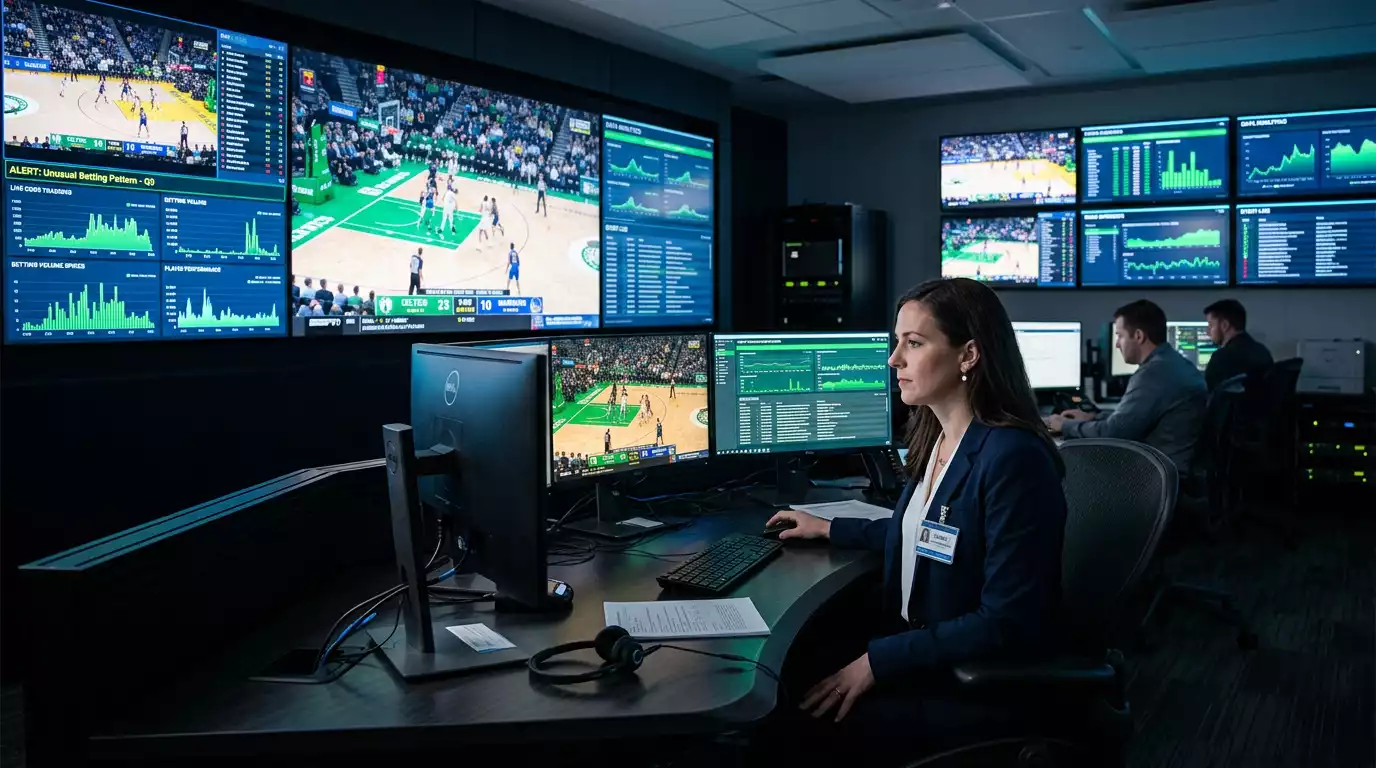
Integrity monitoring has evolved dramatically over the past decade. Where human analysts once manually reviewed betting patterns, algorithmic systems now process millions of transactions in real time, flagging anomalies for investigation. This technological infrastructure represents the most significant integrity improvement since Donaghy’s arrest.
Adam Bjorn, COO of Plannatech, a data provider to integrity monitoring service IC360, described the current state: “The deterrent isn’t that it can’t be done. The deterrent is now [more] eyes on it. There’s people looking.” The surveillance infrastructure has expanded faster than manipulation techniques, at least for traditional forms of corruption.
Machine learning applications are enhancing detection capabilities. Pattern recognition algorithms can identify suspicious betting clusters across platforms and jurisdictions that human analysis would miss. Natural language processing monitors social media and communication channels for signals that might precede or accompany manipulation.
The limitation is that technology detects rather than prevents. By the time suspicious activity triggers investigation, the bets have been placed and often settled. Detection enables prosecution and deterrence but doesn’t stop the first exploitation of corrupt information.
Regulatory Evolution
The regulatory landscape continues developing, though unevenly. In the United States, 38 states plus Washington D.C. now have legal sports betting, each with different frameworks and enforcement capacities. Calls for federal coordination following the 2025 scandal have intensified.
Representative Paul Tonko argued that “voluntary self-policing by the leagues and state regulators should be deemed ineffective. The exclusively state-based regulatory approach is fundamentally flawed.” His SAFE Bet Act would establish federal minimum standards, though political prospects remain uncertain.
UK regulation provides a different model. The Gambling Commission’s statutory levy, stake limits, and enhanced consumer protections demonstrate what comprehensive national regulation can accomplish. Whether American federalism permits similar coordination remains to be seen.
International coordination is expanding through organisations like IBIA, whose members account for over $300 billion in annual betting turnover. These networks enable cross-border information sharing that purely national regulation can’t achieve. But significant betting volume still flows through unregulated channels that don’t participate in monitoring.
League Responses and Market Restrictions
The NBA has advocated for control over which bet types operators can offer on league games. An official memo stated: “Core to the NBA’s position is that sports leagues should have control over the types of bets offered on their games.” This approach would allow selective restriction of vulnerable markets rather than blanket prohibition.
Following the Jontay Porter scandal, sportsbooks agreed to stop offering player props on two-way and 10-day contract players. Similar targeted restrictions might expand to other categories of vulnerable bets. The trade-off is reducing betting options in exchange for integrity protection.
Adam Silver has been explicit about concerns regarding prop bets: “It’s too easy to manipulate something which seems otherwise small and inconsequential to the overall score. There’s nothing more important than the integrity of the competition.” The Commissioner’s statements signal where league priorities lie.
What remains unclear is how much market restriction operators and regulators will accept. Prop bets and same-game parlays generate substantial revenue. Reducing their availability costs sportsbooks money and limits bettor options. Balancing integrity and commerce requires trade-offs that nobody has fully resolved.
Persistent Vulnerabilities
Certain vulnerabilities are likely to persist regardless of reform efforts. Information asymmetry between insiders and markets is inherent to sports. Someone always knows injury status, team chemistry, and preparation details before the public does. That informational edge will always have value to gambling interests.
In-play betting creates manipulation windows that pre-match monitoring doesn’t fully address. The speed and volume of live markets make real-time detection extremely difficult. As in-play betting grows to projected 65% of total volume by 2028, these challenges will intensify.
Organised crime’s interest in sports gambling reflects rational calculation about profit opportunities. The 2025 arrests revealed La Cosa Nostra involvement in NBA betting schemes. Criminal enterprises adapt to new environments. Closing one avenue of exploitation prompts exploration of others.
Global betting markets mean that manipulation orchestrated in one jurisdiction can exploit bets placed in another. No single regulator controls the entire ecosystem. International coordination helps but can’t fully address jurisdictional fragmentation.
Realistic Expectations for UK Bettors
UK punters betting NBA markets should calibrate expectations about what the future holds. Integrity protections will likely improve, but corruption won’t disappear. Detection will accelerate, but some manipulation will succeed before being caught. Market restrictions may reduce some risks while eliminating some betting options.
What’s encouraging is that the trajectory is toward better monitoring, stronger enforcement, and more coordinated response. Each scandal prompts reforms that make the next scandal harder to execute. The gap between corrupt opportunity and detection has narrowed, even if it hasn’t closed.
What’s sobering is that determined actors will continue finding vulnerabilities. The October 2025 arrests came after years of post-Donaghy reforms that were supposed to prevent exactly this kind of scheme. Reform is necessary but not sufficient. Vigilance must be permanent.
For your own betting, the implications are practical. Use licensed operators who participate in monitoring networks. Be cautious with bet types that carry elevated integrity risks. Pay attention to line movements that might signal informed money. And maintain realistic expectations about both the risks you face and the protections that exist.
The history of NBA betting scandals teaches that cycles of corruption and reform are probably permanent features of sports betting. The future will bring better tools for detection and response. It will also bring new methods of exploitation that current systems don’t anticipate. Navigating that environment requires both awareness of progress and humility about its limits.
Looking Forward With Clear Eyes
The future of NBA betting integrity won’t resolve into either complete security or unchecked corruption. Instead, it will remain contested territory where detection capabilities and manipulation techniques evolve in parallel. Expecting permanent solutions sets up disappointment; expecting hopeless vulnerability understates the progress being made.
For UK bettors, this means approaching NBA markets with appropriate perspective. The games you’re betting on attract global interest from sophisticated operators, some legitimate and some not. The monitoring infrastructure provides meaningful but incomplete protection. The regulatory frameworks continue evolving without reaching final form.
What you can control is your own behaviour. Using licensed operators, selecting markets with better integrity profiles, sizing stakes for entertainment rather than investment, and staying informed about developments all reduce your personal exposure to integrity risks. These choices won’t eliminate vulnerability but will position you as well as individual bettors can be positioned.
The fundamental appeal of NBA betting, engagement with compelling athletic competition, remains regardless of integrity concerns. Managing risks appropriately lets you enjoy that engagement without naivety about the environment you’re entering. The future will bring both improvements and new challenges. Being prepared for both is the most realistic approach available.
Will technology prevent future NBA betting scandals?
Technology improves detection but doesn’t prevent manipulation. Algorithmic monitoring identifies suspicious patterns faster than human analysis, but by the time detection occurs, corrupt bets have often been placed and settled. The deterrent is surveillance, not prevention.
What market restrictions might the NBA seek?
The NBA advocates for league control over bet types offered on its games. Following recent scandals, player props on vulnerable athlete categories have been restricted. Similar targeted restrictions on other vulnerable markets may expand, though balancing integrity with commercial interests remains challenging.
Should UK bettors expect NBA integrity to improve?
The trajectory points toward better monitoring and enforcement. Each scandal prompts reforms that make similar schemes harder to execute. But determined actors will continue finding vulnerabilities. Improvement is likely; complete protection isn’t achievable.
Prepared by the nba ref Betting on Games editorial staff.