NBA Betting Integrity Monitoring: How Sportsbooks Detect Fixed Games
 Available in US
Table of Contents
- The IBIA: Global Watchdogs of Betting Integrity
- Real-Time Detection: Catching Corruption as It Happens
- AI and Pattern Recognition: The New Frontier
- Inside the NBA: How the League Monitors Its Own
- The Gaps That Remain: What Monitoring Can’t Catch
- What Comes Next: The Future of Integrity Technology
- How Detection Systems Protect You
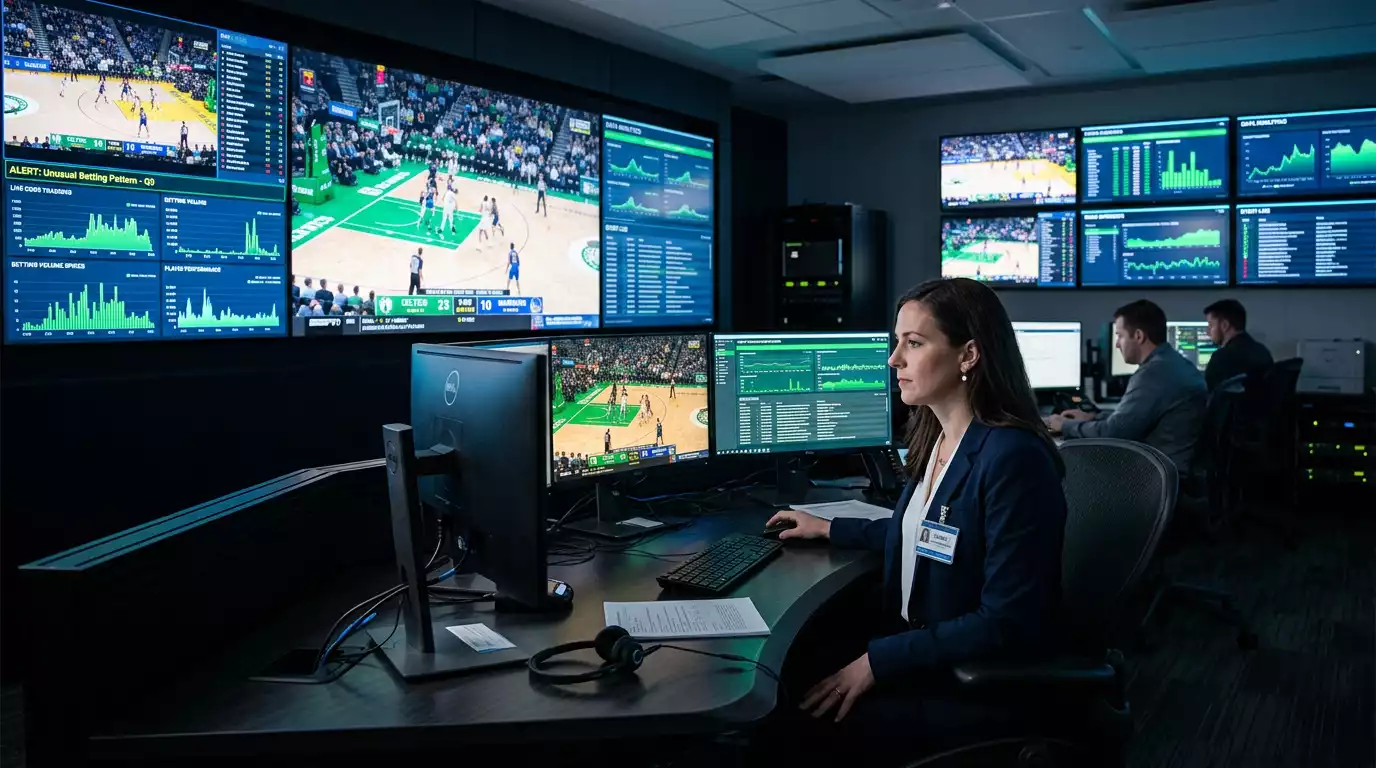
The alert came through on a Tuesday afternoon in March 2023: unusual betting activity on Terry Rozier’s player props, concentrated money appearing on his unders before anyone had reported injury concerns. The monitoring system flagged it in real time. The investigation that followed would eventually lead to 34 arrests and expose one of the most significant gambling conspiracies in NBA history.
That detection — catching suspicious activity as it happened rather than reconstructing it months later — represents the evolution of sports betting integrity monitoring from reactive investigation to proactive surveillance. The systems that identified the Rozier anomaly draw on networks processing over $300 billion in global betting turnover annually, pattern recognition algorithms that never sleep, and cooperative frameworks linking operators, leagues, and regulators across dozens of jurisdictions.
The International Betting Integrity Association reported 59 basketball matches flagged as subject to suspicious betting activity in 2024 alone. Fifty-nine games where something looked wrong enough to warrant investigation. That number reflects both the scale of monitoring capability and the persistence of manipulation attempts in global basketball markets.
What follows is an inside look at how integrity monitoring actually works: who watches, what they’re looking for, and why detection — while vastly improved — still can’t guarantee that every corrupted market gets caught. If you’re betting on NBA games, understanding these systems helps you assess what protection actually exists and where vulnerabilities remain.
The IBIA: Global Watchdogs of Betting Integrity
Before understanding how detection works, you need to understand who’s doing the detecting. The International Betting Integrity Association operates as the primary coordination point for global sports betting surveillance — a role that emerged because no single operator, league, or regulator can monitor everything independently.
IBIA member operators account for over $300 billion of global betting turnover per annum. That coverage means the organisation has visibility into betting patterns across most of the world’s regulated markets. When money moves suspiciously on a basketball game in London, Las Vegas, and Melbourne simultaneously, IBIA’s network can correlate those movements in ways that isolated operators cannot.
The organisation functions as both monitor and coordinator. When suspicious activity appears, IBIA alerts relevant sports bodies, shares information across member operators, and works with regulators to investigate potential manipulation. The value lies not in any single detection capability but in the network effects that come from connecting surveillance systems across jurisdictions.
For those interested in the detailed mechanics of IBIA reporting and how basketball specifically features in their monitoring, I’ve covered the IBIA suspicious betting reports in depth elsewhere. What matters here is understanding the organisation’s role as the connective tissue linking operator surveillance, league integrity departments, and regulatory enforcement.
The Network Behind the Monitoring
The monitoring network draws strength from its breadth. IBIA membership includes major international operators, regional specialists, and niche providers — each contributing surveillance data that, aggregated, creates comprehensive market coverage.
Individual sportsbooks monitor their own betting patterns as a matter of business necessity. Unusual betting activity can signal sharp action, insider information, or manipulation — all of which threaten operator profitability if not identified and addressed. This self-interest aligns with integrity goals: sportsbooks don’t want to be exploited by corrupt actors any more than leagues want their competitions compromised.
The network architecture allows information sharing that isolated monitoring cannot achieve. When suspicious betting appears on a specific game, member operators can compare whether similar patterns appeared across their platforms. Coordinated betting across multiple operators suggests organised action rather than isolated sharp play. That coordination is detectable only through network-level analysis.
UK-licensed operators participate extensively in IBIA monitoring, subjecting their platforms to both Gambling Commission oversight and international integrity surveillance. British bettors wagering through regulated operators benefit from this dual-layer monitoring, though the protection applies to detection rather than prevention.
The coverage gap lies in unregulated markets. Offshore sportsbooks, unlicensed operators, and betting exchanges operating outside regulatory frameworks don’t participate in IBIA monitoring. Sophisticated manipulation schemes can route bets through these channels specifically to avoid detection, exploiting the same jurisdictional arbitrage that enables other forms of financial crime.
How Suspicious Activity Gets Reported
IBIA’s 2024 report flagged 59 basketball matches as subject to suspicious betting activity. That number requires context: it represents global basketball, not just the NBA, including professional leagues across Europe, Asia, and elsewhere. But the figure demonstrates both active monitoring and persistent manipulation attempts across the sport.
The reporting process operates through standardised protocols. When an operator’s monitoring system flags unusual activity, that information flows to IBIA for correlation analysis. If the pattern suggests potential manipulation rather than legitimate sharp action, IBIA alerts the relevant sports governing body and regulatory authorities.
What triggers a suspicious activity report? The criteria include unusual betting volumes, sharp line movements without public information justification, concentrated betting on specific outcomes or players, and patterns that correlate with known manipulation methodologies. Each trigger individually might reflect legitimate market activity; the combination of triggers raises concern.
The 59 basketball alerts in 2024 don’t all represent confirmed manipulation. Suspicious activity warrants investigation, but investigation doesn’t always confirm corruption. Some alerts reflect sophisticated sharp betting that looks suspicious but operates legitimately. Others reveal manipulation attempts that were detected before significant harm occurred. The subset that represents successful undetected manipulation remains unknown by definition.
For bettors, the reporting system provides indirect protection. Markets where suspicious activity was detected may see voided bets, adjusted lines, or trading suspensions. Those interventions protect against some harm while inconveniencing bettors whose wagers happened to coincide with flagged activity.
Real-Time Detection: Catching Corruption as It Happens
The shift from post-hoc investigation to real-time detection represents the most significant evolution in integrity monitoring over the past decade. Systems that once reconstructed suspicious patterns months after games occurred now flag anomalies as betting develops.
Real-time monitoring operates on continuous data feeds. Betting volumes, line movements, account activity, and market correlations flow into analytical systems that compare current patterns against baseline expectations. Deviations trigger alerts that escalate based on severity and confidence levels.
The NBA explicitly acknowledged this capability in communications following the 2025 arrests: “While the unusual betting on Terry Rozier’s ‘unders’ in the March 2023 game was detected in real time because the bets were placed legally, we believe there is more that can be done from a legal/regulatory perspective to protect the integrity of the NBA.”
That statement contains an important qualification: detection occurred because bets were placed through legal, regulated channels subject to monitoring. Wagers placed through unregulated offshore books or international markets with weaker surveillance infrastructure might not have triggered comparable alerts.
The speed of detection matters for limiting harm. When suspicious activity is identified before a game tips off, operators can adjust lines, limit bet sizes, or suspend markets entirely. When detection occurs during games, in-play betting can be restricted. These interventions don’t prevent the underlying corruption but can limit the financial extraction enabled by manipulation.
The Rozier Detection: A System That Worked
The Rozier case provides the clearest public example of real-time detection functioning as designed. The sequence illustrates both the system’s capabilities and its limitations.
On 23 March 2023, monitoring systems detected unusual concentration of money on Terry Rozier’s under props before the Miami Heat faced New Orleans. The betting volume was disproportionate to normal activity on a regular season game featuring a mid-tier player. The pattern flagged automated alerts that escalated to human review.
Rozier subsequently played only 9 minutes and 36 seconds before exiting with a reported foot injury. The under bets cashed. The correlation between suspicious pre-game betting and actual game outcome was exactly what detection systems are designed to identify.
What followed the detection took more than two years. The March 2023 alert triggered investigation, but investigation requires evidence gathering, cooperation from multiple parties, and federal prosecutorial resources. The October 2025 arrests came 31 months after the initial detection — a timeline that reflects both investigative thoroughness and the gap between identifying suspicious activity and building prosecutable cases.
The detection worked. The bettors who placed informed money on Rozier’s unders that night still won. The manipulation succeeded even though monitoring systems identified it in real time. That outcome reveals the fundamental limitation: detection without prevention means corrupt actors can extract profit before consequences arrive.
For legitimate bettors who happened to take the other side of that market, the detection provided no protection. They lost money to informed opponents, and the fact that those opponents were eventually investigated offers no restitution.
AI and Pattern Recognition: The New Frontier
The next generation of integrity monitoring relies increasingly on artificial intelligence and machine learning systems capable of identifying patterns too subtle for human analysts to detect reliably.
Adam Bjorn, COO of Plannatech, a data provider working with integrity monitors, described the current landscape: “The deterrent isn’t that it can’t be done. The deterrent is now more eyes on it. There’s people looking.” That framing acknowledges a pragmatic reality: manipulation remains possible, but surveillance density has increased the risk of getting caught.
AI-powered monitoring processes vastly more data than human analysts could review. Every bet, every line movement, every account interaction across participating operators feeds into systems that compare current activity against historical baselines, peer markets, and known manipulation signatures.
Pattern recognition algorithms excel at identifying correlations humans might miss. When betting activity on a player’s props correlates with that player’s performance across multiple games, AI systems can detect the pattern even if no single game triggered individual alerts. The aggregate analysis catches schemes that operate below single-game detection thresholds.
For a deeper examination of where this technology is heading and what remains beyond current capabilities, I’ve covered the future of AI in sports betting integrity separately. The trajectory points toward increasingly sophisticated surveillance, but each advancement in detection prompts corresponding evolution in evasion techniques.
Inside the NBA: How the League Monitors Its Own
Beyond external monitoring networks, the NBA operates its own internal surveillance apparatus — systems developed and refined in direct response to the Donaghy scandal that exposed how little the league knew about corruption operating within its officiating corps.
The Pedowitz Report commissioned after Donaghy’s arrest found troubling gaps in league oversight. Among its findings: 52 of 57 NBA referees interviewed had engaged in some form of gambling, though not on NBA games. That discovery — legal gambling by people prohibited from betting on their own sport — demonstrated the permeable boundary between officiating culture and gambling activity.
Post-Donaghy reforms tightened internal controls substantially. Background checks on officials became more rigorous. Monitoring of referee activities outside game assignments intensified. The league developed relationships with integrity monitoring firms that provided independent surveillance supplementing internal systems.
The NBA also implemented betting market surveillance that tracked line movements on games its referees officiated. When lines moved sharply before games, especially in patterns correlated with specific officiating assignments, internal systems flagged the activity for investigation. That monitoring addressed the specific vulnerability Donaghy exploited: advance knowledge of which referee would work which game.
League communications following the 2025 arrests indicated ongoing investment in integrity infrastructure: “We believe there is more that can be done from a legal/regulatory perspective to protect the integrity of the NBA.” That phrasing suggests both confidence in current detection capabilities and recognition that internal monitoring alone is insufficient.
The Assignment Timing Change That Limited Corruption
One of the most concrete post-Donaghy reforms targeted the specific mechanism his scheme exploited: advance knowledge of referee assignments. Before the scandal, officiating assignments were announced approximately 90 minutes before tip-off, providing a window for interested parties to place bets informed by which referees would work the game.
The NBA shifted to same-morning announcements, dramatically compressing the window between when betting syndicates could learn assignment information and when they could act on it. Morning announcements meant less time for coordinated betting across multiple accounts and markets before tip-off.
The reform directly addressed informational value. Every hour of advance notice provided opportunity for bets to be placed at odds that didn’t yet reflect officiating implications. Reducing that window reduced exploitable advantage. It didn’t eliminate the underlying vulnerability — a corrupt referee still knows his own assignments — but it limited what external actors could do with that knowledge.
Assignment timing changes also complicated coordination between corrupt officials and betting partners. Communication needed to happen faster. Bet placement needed to be more efficient. The logistical burden of exploitation increased even as the fundamental possibility remained.
The effectiveness is difficult to measure precisely. We can’t observe manipulation that didn’t occur because the timing change deterred it. What we can observe is that post-reform detection hasn’t identified patterns comparable to the Donaghy era’s systematic exploitation of assignment information. That absence might reflect deterrence, improved operational security by would-be corrupters, or simply luck.
The Gaps That Remain: What Monitoring Can’t Catch
Jason Van’t Hof, formerly Vice President of Investigations at IC360, an integrity monitoring firm, offered a sobering assessment: “We’re in a bit of a watershed moment this year.” That phrasing — watershed moment — suggests recognition that current systems face challenges they weren’t designed to address.
The fundamental limitation is that monitoring detects patterns, not intentions. Unusual betting activity might reflect corruption, sophisticated sharp play, or random variance. Distinguishing among these possibilities requires investigation that takes time, during which bets have already been settled and money has already changed hands.
Consider the analytical challenge from a monitoring perspective. A betting account places $10,000 on a player prop at unusual odds. Is that corruption, confidence based on legitimate analysis, or simply a wealthy recreational bettor making an aggressive play? The bet itself provides no answer. Only context — account history, correlation with other suspicious activity, eventual game outcome — permits assessment. And gathering that context takes time the market doesn’t provide.
Unregulated betting channels represent a structural blind spot. IBIA monitoring, NBA internal surveillance, and operator detection systems all depend on access to betting data. Wagers placed through unlicensed offshore books, underground betting networks, or international markets with weak transparency requirements don’t appear in these systems. Sophisticated manipulation routes bets through these channels specifically to avoid detection.
The geographic scope of NBA betting complicates monitoring. Basketball attracts significant wagering volume in Asia, where regulatory frameworks differ substantially from US and European standards. Drew Dinsick’s observation that informed bettors “could get into accounts in Asia for NBA” and wager “high six figures” highlights the jurisdictional arbitrage available to manipulation schemes.
Perhaps most fundamentally, detection without prevention offers limited protection. The Rozier betting was detected in real time. The bets still won. The investigation took years. Corrupt actors willing to accept eventual exposure in exchange for immediate profit can exploit the gap between detection and consequence.
What Comes Next: The Future of Integrity Technology
The trajectory of integrity monitoring points toward increasing technological sophistication, broader data integration, and more aggressive intervention — though each advancement faces corresponding evolution in evasion techniques.
Machine learning systems will process more data with greater pattern sensitivity. Biometric monitoring of player performance might eventually flag physical underperformance inconsistent with expected capability. Blockchain-based betting records could improve transparency across jurisdictions. Each technology offers incremental improvement in detection capability.
The integration of performance data with betting data represents a particularly promising frontier. Current systems primarily monitor market activity — betting volumes, line movements, account patterns. Future systems might correlate that market data with in-game performance metrics in real time. A player whose biometric indicators suggest normal physical condition but whose performance suddenly declines creates a data signature worth investigating.
Regulatory coordination represents another frontier. The NBA’s advocacy for greater control over bet types reflects league interest in limiting manipulation opportunities at the product design level rather than relying solely on post-hoc detection. If leagues gain authority to prohibit specific bet types deemed too vulnerable — certain player props, granular in-game markets — the attack surface for manipulation narrows.
The US sports betting market reached $16.96 billion in revenue during 2025, a 22.8 percent increase from the previous year, with total handle of $166.94 billion. That growth rate — market size nearly doubling every few years — means integrity infrastructure must scale correspondingly. The monitoring systems adequate for a $100 billion handle market may prove insufficient for a $200 billion market.
What seems unlikely is elimination of manipulation risk. The incentives remain enormous. The vulnerabilities are structural. The arms race between detection and evasion continues indefinitely. Future systems will catch more corruption faster, but the fundamental dynamic — that sports betting creates value for inside information and that some people will exploit that value corruptly — isn’t going away.
For bettors, the practical implication is informed skepticism. Integrity monitoring provides genuine protection compared to the unmonitored markets of previous eras. But that protection is partial, detection-focused rather than prevention-focused, and subject to gaps that sophisticated actors can exploit. Betting on NBA games means accepting residual integrity risk that no current system can eliminate.
How Detection Systems Protect You
How do sportsbooks detect suspicious betting activity?
Sportsbooks monitor betting volumes, line movements, account activity, and market correlations through automated systems that compare current patterns against baseline expectations. Deviations trigger alerts that escalate based on severity. The IBIA network coordinates detection across members accounting for over $300 billion in annual betting turnover.
What role does the IBIA play in the broader integrity ecosystem?
The International Betting Integrity Association serves as the primary coordination point for global sports betting surveillance. When suspicious activity appears, IBIA alerts relevant sports bodies, shares information across member operators, and works with regulators to investigate potential manipulation. The network effects from connecting surveillance systems across jurisdictions provide detection capability no single operator could achieve independently.
How was the unusual betting on Terry Rozier detected in real time?
Monitoring systems flagged unusual concentration of money on Rozier’s under props before the March 2023 game against New Orleans. The betting volume was disproportionate to normal activity, and the pattern triggered automated alerts. The NBA confirmed this real-time detection occurred because bets were placed through legal, regulated channels subject to monitoring.
What happens after suspicious activity is reported to regulators?
Suspicious activity triggers investigation by relevant sports governing bodies and regulatory authorities. Investigations require evidence gathering, cooperation from multiple parties, and sometimes federal prosecutorial resources. The gap between detection and consequences can span years — the Rozier alert in March 2023 led to arrests in October 2025, a 31-month timeline.
Created by the ”nba ref Betting on Games” editorial team.